


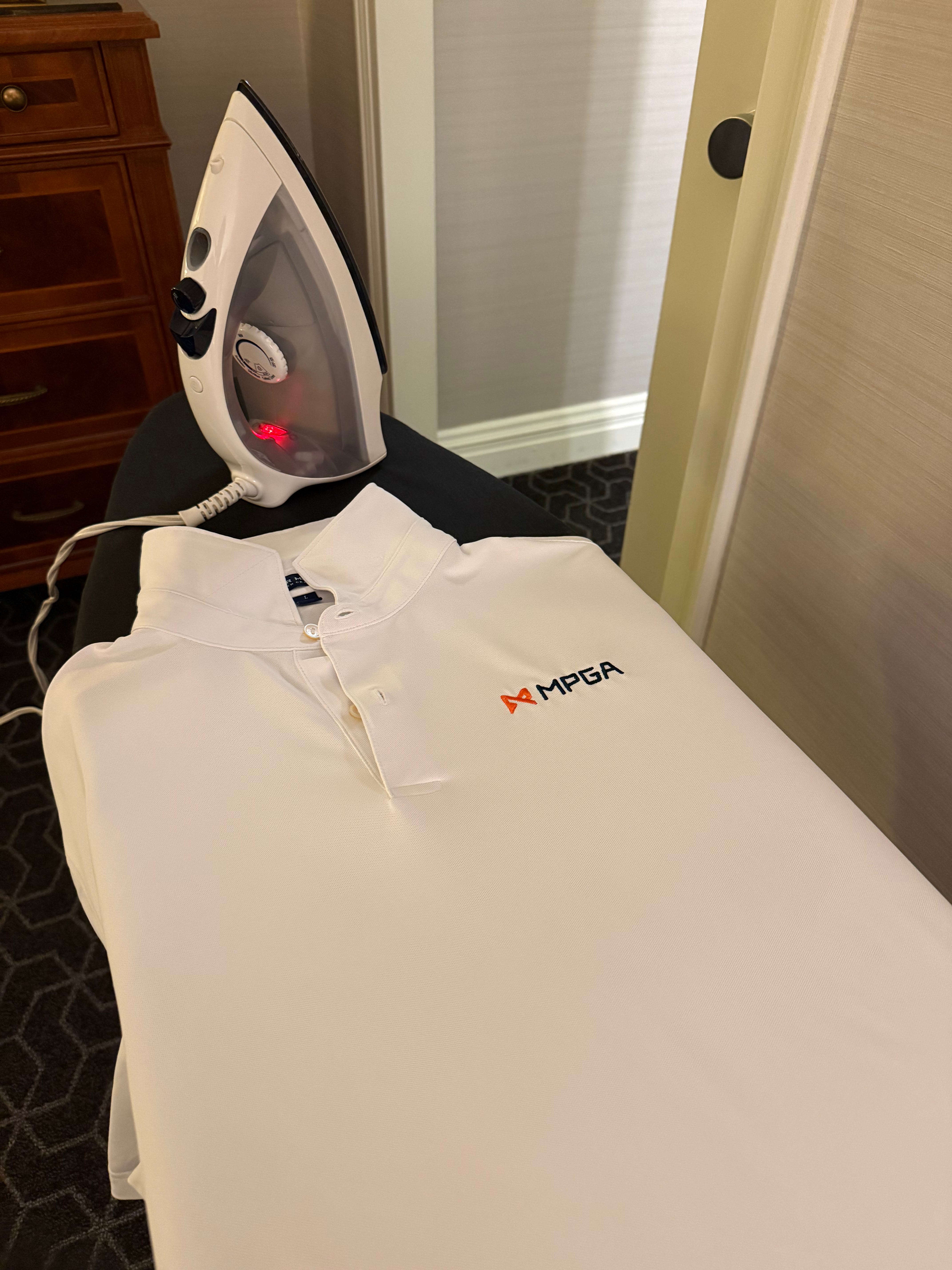
I’ll be the first to admit it. I’m not great at ironing clothes.
That’s not easy to say as someone who coaches mental performance for a living. But here I am, standing in front of an ironing board, MPGA polo laid out flat, iron in hand, making things worse.
More creases. Not fewer.
I knew I was doing something wrong. That’s the whole point of ironing, right? Remove the wrinkles. But the faster I moved, the more I pressed and rushed, the worse it got. I caught myself pushing harder, moving quicker, as if sheer force and speed would fix what I was getting wrong.
And then it hit me.
I do the exact same thing on the golf course.
Speed Is Not the Answer
When I make a mistake on the course, I notice a pattern. I speed up. My pre-shot routine gets shorter. My breathing gets shallower. My grip tightens. I start rushing to the next shot as if moving faster will erase what just happened.
Psychologists call this behavioral acceleration. It’s what happens when anxiety spikes and your nervous system pushes you toward action. You feel the need to do something fast to regain control. But that urgency usually creates the opposite effect. You dig the hole deeper.
Research by Dr. Roy Baumeister and his colleagues on ego depletion tells us that after a perceived failure, self-regulation weakens. You’re more prone to impulsive responses. That’s when patience becomes a skill, not just a personality trait.
The Research on Slowing Down
The field of sport psychology has studied post-error responses for decades. One of the most consistent findings is this:
Elite performers slow down after mistakes.
They don’t rush the next play.
They reset.
Researchers Kuchar, Neff, and Mosewich developed the RESET intervention specifically for athletes dealing with mistakes mid-performance. The protocol is straightforward. Recognize what happened, extract the lesson, and start fresh.
Each step requires a deliberate pause. You won’t do any of them well if you’re racing to the next shot.
Dr. Kristin Neff’s self-compassion research adds another layer. She found that people who respond to their mistakes with harsh self-criticism tend to overthink and over-correct. Self-compassion, on the other hand, leads to faster recovery because it eliminates the mental spiral that follows a bad shot (something we focus on and teach at www.mpgagolf.com).
The golfer who shanks one into the trees and says “I’m the worst” is already fighting two battles. The shot that went wrong. The story they’re now telling about themselves.
One Stroke at a Time
Back at the ironing board, I stopped.
I took a breath. I slowed my stroke. I focused on one section of fabric at a time. I stopped trying to fix everything at once.
The wrinkles started to come out.
That’s the lesson. Patience on the golf course works the same way. After a bad shot, you do not need speed. You need presence. One breath. One target. One swing.
Your brain is not designed to perform well under urgency you create yourself. When you manufacture that pressure, you activate your threat response. Your motor control narrows, and your decision-making suffers. The research on attentional focus by Dr. Gabriele Wulf shows that external focus (thinking about where the ball needs to go) beats internal focus (thinking about your swing mechanics). But you won’t access external focus if your mind is racing.
Slow down. You give yourself the best chance when you reset your nervous system between shots, not when you punish yourself into action.
A Simple Patience Protocol for the Course
The next time you make a mistake on the golf course, try this:
Walk slowly to your next shot. Not dramatically. Just slower than your instinct tells you.
Take one full breath before you pull a club. Breathe in for four counts. Out for six.
Pick one external target. A spot on the fairway. The top of the flag. The entry point on the green. One thing.
Commit to the shot, not the outcome.
That’s it. No complex mental overhaul. No sport psychology jargon to memorize between holes. Just the same principle I learned ironing a polo shirt at 10:30pm, the night before my big day at the Baltursol Golf Club in New Jersey.
Slow is smooth. Smooth produces results.
Your Mental Coach,
Dr. Mat Mental Performance Golf Academy mpgagolf.com ONE: A Spiritual Playbook for the Mental Game of Golf