

What Astronauts Can Teach Junior Golfers About Performance
7 Principles on Building a High Performance Mindset by a NASA Psychologist

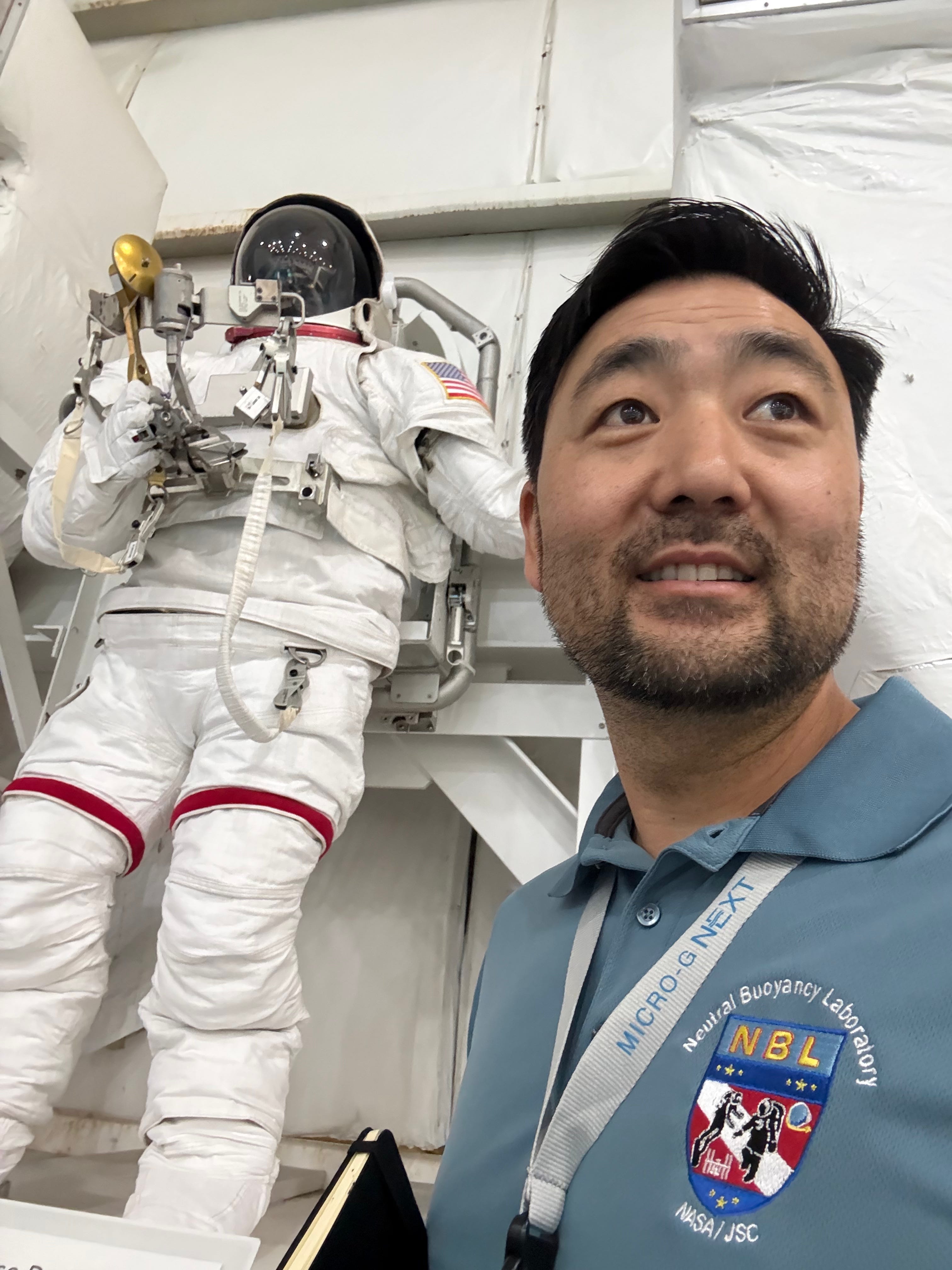
At NASA’s Neutral Buoyancy Lab sits a mural depicting an astronaut posed as Leonardo da Vinci’s Vitruvian Man. The artwork doesn’t celebrate what the astronaut looks like. It celebrates what the astronaut embodies: human excellence through deliberate, integrated preparation.
An astronaut doesn’t become high-performing by accident. Neither does a competitive golfer.
The astronauts preparing for space missions spend years in training that most athletes never experience. The consequences of these performers are absolute. One miscalculation. One moment of distraction, or one deviation from process and everything fails.
Yet within that pressure, astronauts perform with precision. They execute complex procedures. They adapt to emergencies and train themselves to remain calm when systems fail.
This is not natural. This is trained. And the training methods used by NASA reveal exactly what junior golfers need to perform at their highest level.
Why Astronauts Matter to Your Golf
Golf and space training share one critical element: the outcome depends entirely on what happens between your ears and how you execute one step at a time.
A golfer stands over a four-foot putt. The ball is stationary. The hole doesn’t move. The physics doesn’t change. Yet golfers miss makeable putts under pressure while making the same putt casually during practice.
An astronaut executes a spacewalk. The procedure is planned. The movements are rehearsed. The suit works the same way every time. Yet astronauts undergo 1,400 hours of underwater training to prepare for one seven-hour spacewalk.
Why? Because the human mind, under pressure, abandons process. It panics. It rushes. It attaches outcome to identity.
Astronauts train to prevent this. They train to own the moment, no matter the stakes.
This is the performance advantage every junior golfer needs.
Principle 1:
Rigor in Preparation Equals Freedom in Performance.
Astronauts spend the vast majority of their time preparing for moments that last seconds. A spacewalk procedure that lasts seven hours in space has been practiced for over 1,400 hours on Earth.
That’s a 200-to-1 preparation ratio.
Most junior golfers practice the opposite. They hit balls casually. They play casually. Then they expect to perform under pressure.
Astronauts know the truth: preparation buys freedom. The more rigorous your preparation, the calmer you become in high-pressure moments because your body knows the procedure.
Your nervous system doesn’t distinguish between real pressure and simulated pressure. When you rehearse with the same intensity as competition, your body learns: “This is normal. I’ve done this thousands of times.”
Casual practice trains casual performance. Rigorous practice trains competitive performance.
What this looks like for you:
Your practice must have standards. Not just reps. Standards.
If you’re working on your short game, establish a protocol. Before each shot: read the break, visualize the line, commit to a speed, execute without hesitation. Do this for 50 shots. The 50th shot is performed with the same precision as the first.
If you’re working on your full swing, practice specific targets under specific conditions. Not: “I’ll hit some drivers.” Instead: “I’ll hit 15 drivers to targets 200-205 yards, with a specific shape, from specific stances.”
Track your performance in practice. Astronauts track every rehearsal. So should you.
Your goal is to reach a point where your body executes procedures without conscious thought because those procedures have been embedded through repetition and rigor.
Principle 2:
Process Over Outcome, Moment by Moment.
NASA’s Mission Control doesn’t ask astronauts, “Win the spacewalk.” Instead, they direct the astronaut through a precise sequence of movements. Step by step. Hand by hand.
The flight director might say: “We’re moving to depressurization protocol. Disconnect the primary umbilical first. Verify the secondary is engaged. Now rotate your body 47 degrees to the left. Move your right foot forward two feet. Stop and verify foot placement.”
This isn’t micromanagement. This is excellence.
The astronaut isn’t thinking about the spacewalk. The astronaut is thinking about the next step. The next movement. The next decision point.
This is why astronauts own catastrophic pressure. They’re not managing the entire mission in their mind. They’re managing the next 30 seconds.
When consequence is high, narrow your focus. Not on the outcome. On the process.
A junior golfer walking to the first tee in a tournament often mentally plays the entire back nine before hitting the opening drive. Anxiety explodes. Performance crumbles.
An astronaut in a spacewalk when a system fails doesn’t think, “This could kill me.” The astronaut thinks, “Okay. What’s the next step in the emergency protocol?”
Same nervous system. Different training.
What this looks like for you:
Develop a pre-shot routine that narrows your focus to the moment. Not the score. Not the outcome. The process.
Walk to your ball. Assess the lie. Choose your target. Choose your shot shape. Choose your club. Take practice swings. Commit. Execute. Step away.
That’s one execution. One moment. That’s all you manage.
In competition, you perform 70+ of these routines. You can’t control 70 outcomes. You can control one routine. Then the next one.
During practice, train this skill. When you hit a shot, don’t evaluate it immediately. Reset. Perform the next routine with full attention. This trains your mind to stay in process mode instead of outcome mode.
Astronauts train this same skill. They rehearse procedures knowing that once in space, their thoughts must remain on the current step, not the larger mission.
Principle 3:
Communication Creates Clarity and Corrects in Real Time.
Mission Control doesn’t send astronauts into space with vague instructions. Every procedure is documented. Every step is communicated. Every decision point has been discussed.
But communication doesn’t end at launch. Throughout the mission, the flight director remains in constant dialogue with the astronaut. The director provides information. The astronaut provides status updates. Together, they stay synchronized.
If the astronaut deviates from procedure by even a small margin, Mission Control recognizes it immediately and communicates a correction. Not months later. In real time.
Most junior golfers train in isolation. They hit balls at a range without feedback. They play rounds without analysis. Then they wonder why they don’t improve.
Improvement requires feedback. It requires communication between coach and player about what’s actually happening versus what should be happening.
What this looks like for you:
If you’re working with a coach, use that relationship fully. Don’t just hit balls. Discuss your tendencies. Discuss your competitive patterns. Discuss what you’re working on in specific situations.
Ask your coach: “What happens to my swing when I’m anxious?” “What’s my pattern when I miss fairways?” “How does my short game change under pressure?”
Video analysis works here. Film yourself during competitions. Film yourself during practice. Compare them. Where do you deviate?
If you’re training independently, communicate with yourself. Keep a journal. Track patterns. Write down: “I rushed this putt.” “I didn’t commit to this shot.” “I hit 8 fairways today and 6 of them came when I slowed my routine.”
This isn’t about perfection. It’s about recognition. You can’t correct what you don’t see.
For parents: ask your junior golfer about their round in specific terms. Not: “How did you play?” Instead: “Tell me about how you stayed committed to your routine. Were there moments you rushed? What happened with your short game?”
This creates feedback loops. Feedback loops create awareness. Awareness creates change.
Principle 4:
Precision in Execution, Down to the Degree.
Here’s what the astronaut hears from Mission Control during a spacewalk: “Rotate your body 37 degrees counterclockwise. Move your left foot forward precisely 2.5 feet. Now pivot on your right foot and face the service panel.”
Not: “Turn around and work on the panel.”
Precise. Measured. Intentional.
The astronaut doesn’t approximate. The astronaut executes exactly.
Why? Because in space, approximation can be fatal. And this culture of precision transfers to every step of training, not just the dangerous ones.
Junior golfers often practice with approximation. They aim at a general area instead of a specific target. They swing with approximate tempo instead of deliberate tempo. They commit to shots with approximate commitment instead of full commitment.
This trains approximation. And approximation is what shows up on the course.
What this looks like for you:
When you practice, eliminate generalities. Not: “I’ll work on my irons.” Instead: “I’ll hit 5-irons to the 160-yard marker with a specific shape. I’ll draw 5, fade 3, keep 2 straight.”
Know your actual distances. Not your estimated distances. Know them by testing and tracking. Know that your 7-iron goes 153 yards on average with your swing, in calm conditions.
When you practice a short game shot, don’t just chip the ball to “somewhere near the hole.” Chip to specific feet. Every chip has a target of 3 feet.
When you set up to a golf shot, commit fully. Not 80% sure. 100% committed. If you’re not fully committed, step away and reset.
This precision transfers to competition because you’ve trained precision. Your nervous system knows what committed execution looks like.
Principle 5:
High Involvement, Low Attachment.
This is the astronaut’s mental posture in moments of extreme consequence.
The astronaut is fully engaged. Every system is being monitored. Every movement is deliberate. Every step is important. This is high involvement.
Simultaneously, the astronaut is not attached to controlling the outcome. The astronaut is attached to controlling the process. The astronaut executes the procedure exactly and then trusts the procedure. This is low attachment to outcome.
High involvement in the process. Low attachment to controlling what happens next.
When a system fails during a spacewalk, the astronaut doesn’t panic or freeze. The astronaut is fully involved in responding to the immediate problem while remaining unattached to whether the overall mission succeeds. The astronaut’s job is to follow protocol. Mission Control’s job is to manage outcomes.
This mental separation is powerful.
Most junior golfers do the opposite. They have low involvement (they’re distracted or rushing) and high attachment (they’re obsessing over the score, over what others think, over the outcome).
This creates anxiety. Anxiety creates mistakes. Mistakes create worse scores. And the cycle continues.
What this looks like for you:
Before you execute a golf shot, be fully involved. Full focus. Full commitment. Full presence. This is high involvement.
During execution, you are 100% about the routine. Nothing else exists. The score doesn’t exist. The leaderboard doesn’t exist. The spectators don’t exist. The consequence doesn’t exist.
After you execute the shot, let it go. Immediately. You’ve done your job. The ball now follows physics. You’ve already moved to the next moment.
This mental shift changes everything. You’re not trying to control the outcome. You’re controlling your process. The outcome follows.
For parents: help your junior golfer understand this distinction. After a round, don’t ask about the score first. Ask about their process. “How did your routine hold up?” “Did you stay committed to your pre-shot routine?” “What moments did you rush? What moments did you own?”
This teaches your golfer that you value process over outcome. Your golfer’s nervous system learns to prioritize what matters: the execution.
Principle 6:
Owning The Moment, Regardless of Stakes.
An astronaut training for a spacewalk knows the risks. System failure. Equipment malfunction. Loss of oxygen. These are real. These are catastrophic.
Yet the astronaut’s training creates a psychological state where the astronaut thinks: “Okay. Here’s what happens next. I’ve trained for this. I own this moment.”
This isn’t arrogance. This is earned confidence. The astronaut has rehearsed the procedure thousands of times. Has trained emergency responses. Has studied every variable. The astronaut walks into that moment with preparation that exceeds the challenge.
This is what competitive golfers need. Not false confidence. Earned confidence.
You earn confidence by doing the work. By practicing with rigor. By rehearsing your routines under pressure conditions. By analyzing your patterns. By building mental tools through deliberate practice.
When you stand on the first tee in a tournament, you should think: “I’ve trained for this. I own this moment. I’m going to execute my routine and let the score follow.”
This isn’t visualization. This is preparation meeting moment.
What this looks like for you:
Before your next competition, ask yourself: “Have I done the work?” If the answer is yes, then you own that moment. You’ve earned the right to be confident.
If the answer is no, then your job isn’t to fake confidence. Your job is to return to preparation. Close the gap between where you are and where you want to be.
The astronauts with the highest performance records aren’t the ones with the most natural talent. They’re the ones with the most rigorous preparation. The ones who refuse to step into high-stakes moments unless they’ve done the work.
Your path is the same.
Principle 7:
Build Your Complete Performance Plan (Craft, Body, Mind).
The Vitruvian Man represents integrated human excellence. Not just physical. Not just mental. All systems working together.
Your performance as a golfer requires the same integration.
Your body must be trained. Your swing mechanics must be developed. Your fitness must support your game. This is the technical foundation.
Your mind must be trained. Your routines must be rehearsed. Your decision-making must be practiced under pressure. Your emotional responses must be managed through deliberate skill-building. This is the performance foundation.
And everything must be integrated. Your mind executing your body’s procedures. Your body supporting your mind’s focus. One system.
Astronauts train this integration for years before stepping into a spacecraft. You can train this integration in your golf development.
Your Next Step
You now understand the principles. The question is implementation.
Start with one. Choose the principle that speaks to your current challenge.
If you’re struggling with inconsistency, focus on Principle 1: Rigor in Preparation. Audit your practice. Raise your standards. Train with the intensity of competition.
If you’re struggling with pressure, focus on Principle 2: Process Over Outcome. Develop a solid pre-shot routine. Practice it relentlessly. During competition, trust the routine and let outcomes follow.
If you’re struggling with feedback and improvement, focus on Principle 3: Communication. Find a coach or analyst who can identify your patterns. Journal your rounds. Track what’s actually happening.
If you’re struggling with execution, focus on Principle 4: Precision. Stop approximating. Train specific targets. Develop commitment skills.
If you’re struggling with mental pressure, focus on Principle 5: High Involvement, Low Attachment. Train the ability to be fully present and fully committed while remaining unattached to controlling the outcome.
Pick one. Work that principle for 30 days. Then add the next.
This is how astronauts build excellence. Not all at once. Layer by layer. System by system. Until they’re ready for the moment.
You’re building the same way.

A Question for Reflection
What principle above identified your biggest gap between where you are and where you want to be? More importantly, what specific action will you take this week to close that gap?
The astronauts are already training. They’re already owning their moments. The question is: will you?
Your Mental Coach,
Dr. Mat

About Dr. Mat Park
Dr. Mat Park is a mental performance coach, sport psychologist, and author dedicated to helping junior golfers, collegiate players, and serious amateurs build championship-level mindsets. His work bridges golf psychology, high-performance leadership, and faith-based personal development.
As founder of the Mental Performance Golf Academy (MPGA), Dr. Mat works with golfers who want to close the gap between their technical skill and their competitive performance. He’s the author of ONE: A Spiritual Playbook for the Mental Game of Golf, a framework that thousands of golfers use to strengthen their mental game. He also co-hosts the Mind Your Game podcast with LPGA Tour winner Cydney Clanton, where they discuss real performance challenges from competitive golfers.
Dr. Mat’s approach is grounded in research and built on lived experience. He draws on frameworks from Kristin Neff’s self-compassion work, Roy Baumeister’s performance psychology, and sport psychology research. He’s direct. He’s honest about his own struggles with consistency. And he’s committed to helping golfers and parents understand that mental performance is a skill that can be trained, just like your swing.
When he’s not coaching golfers, Dr. Mat supports leadership development and contracts with NASA in engineering and operations.

About the Mental Performance Golf Academy (MPGA)
MPGA is a platform for athletes, parents, and coaches who understand that mental performance is the difference between talent and results. The academy serves junior golfers, collegiate players, and serious amateurs who want to develop the mental skills that close the gap between practice performance and competitive performance.
MPGA offers direct coaching, online courses, and resources grounded in sport psychology research. The academy teaches golfers how to build routines that work under pressure, manage emotions during competition, recover quickly from mistakes, and maintain focus when stakes are highest. The focus is always on skills you can train, not qualities you’re born with.
MPGA also produces the Mind Your Game podcast, featuring real conversations with competitive golfers about the mental challenges they face. The podcast connects research to practical performance problems, giving golfers insight into how others navigate pressure and overcome mental barriers.
The academy’s philosophy is simple: your mental game is a skill. Like your swing, it improves through deliberate practice, honest feedback, and commitment to process over outcome.
Connect with Dr. Mat and MPGA
MPGA website and coaching: mpgagolf.com
ONE Daily Devotional app: www.playforoneapp.com
Mind Your Game podcast: Available on all major podcast platforms
MPGA Instagram: https://www.instagram.com/mpga.golf/
18 Holes Weekly Mindset Newsletter: https://www.drmatpark.com/s/18-holes-newsletter