


I used to think the round ended on the 18th green. It does not. For your kid, it ends in the car.
My daughter and I played in a father-daughter match (nothing serious) but as competitive as she is, she posted a number she hated. I watched her walk off the green with her shoulders down. I had a whole speech ready. Three things she could fix, and I meant well. I started talking before she had the door closed.
By the time we hit the highway, she was crying and I was frustrated. We both lost that ride. Without even realizing it, I was the dad who made it worse.
“Many young golfers feel more anxious getting into the car with their parents after a tournament than they feel at the start of one.”
What psychology says.
Two things are happening in that car, and both work against the talk you want to have.
First, ego depletion. Dr. Roy Baumeister’s research shows self-control runs on a limited tank. Four or five hours of competition drains it. Your kid has nothing left to process feedback. You are coaching an empty battery.
Second, threat response. A question like “Why did you three-putt 14?” lands as a threat, not curiosity. The brain shifts into defense. Learning shuts off. You cannot teach a kid whose system is bracing for impact.
This is where self-compassion changes the outcome. Dr. Kristin Neff’s work shows that athletes who treat themselves with kindness after failure recover faster and perform better next time than those who pile on criticism. Your kid learns that tone from you. The car ride is where they learn whether mistakes are safe.
You do not need to fix anything in that car. You need to keep it safe.
The faith layer
My daughter needs to know my love does not move with her score. That is the whole thing. Grace does not check the leaderboard. If I only light up when they play well, I teach them they are worth what they shoot. That is a lie I never want them to believe.
The car ride is a small place to practice a larger truth. You are loved on your worst day, not because of the round, but in spite of it.
The Playbook for the Car Ride Home:
Try this the next time the round goes sideways. It takes about four minutes.
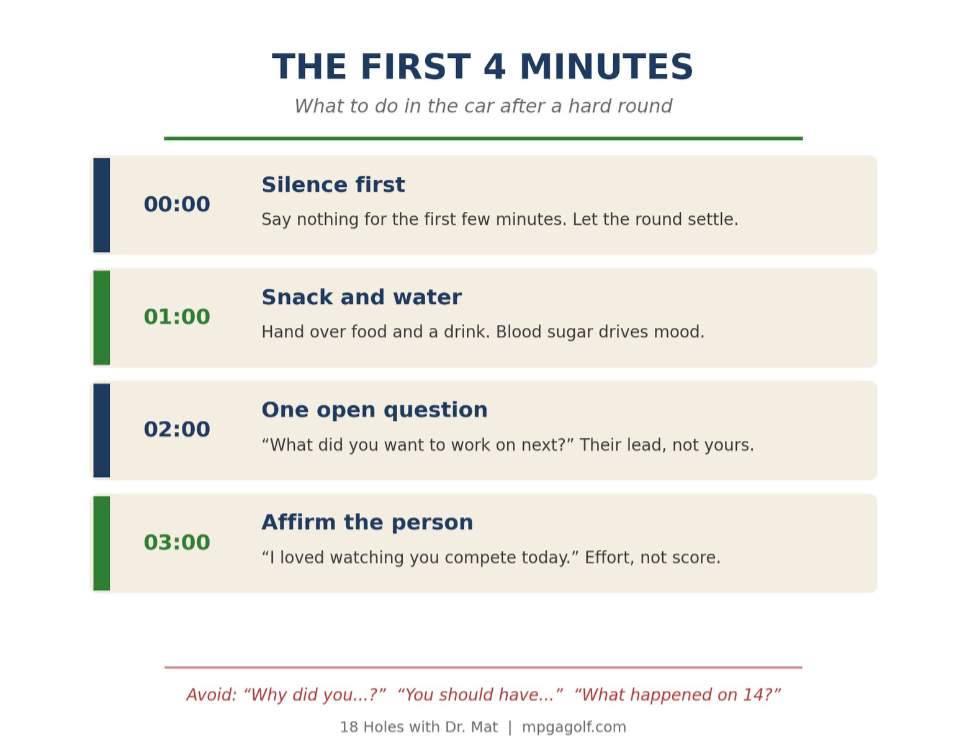
Step 1: Stay silent first. Say nothing for the first few minutes. No questions. No fixes. Let the round settle. Your silence tells them the car is safe.
Step 2: Hand over food and water. Blood sugar drives mood after a long round. A snack and a drink do more for the conversation than any advice you have.
Step 3: Ask one open question, then stop. Try “What do you want to work on next?” Let them lead. If they want to talk, follow. If they do not, let it go.
Step 4: Affirm the person, not the score. “I loved watching you compete today.” Praise effort and attitude, never the number. Process praise builds kids who keep trying. Outcome praise builds kids who fear failing.
Notice what is missing. Avoid starting your sentence with “Why did you...?” or “You should have...” And no swing breakdown. The lesson can wait for the range. The car is for the relationship.
One reflection before you drive
Picture your kid five years from now. What do you want them to remember about these car rides? The corrections you gave, or the safety you built? You get to choose that today, one ride at a time.
Your Mental Coach,
Dr. Mat
P.S. In this episode on Mind Your Game, we went deep on parent and athlete dynamics. If the car ride hits home, that one is worth a listen.
Dr. Mat | mpgagolf.com | ONE: A Spiritual Playbook for the Mental Game of Golf