


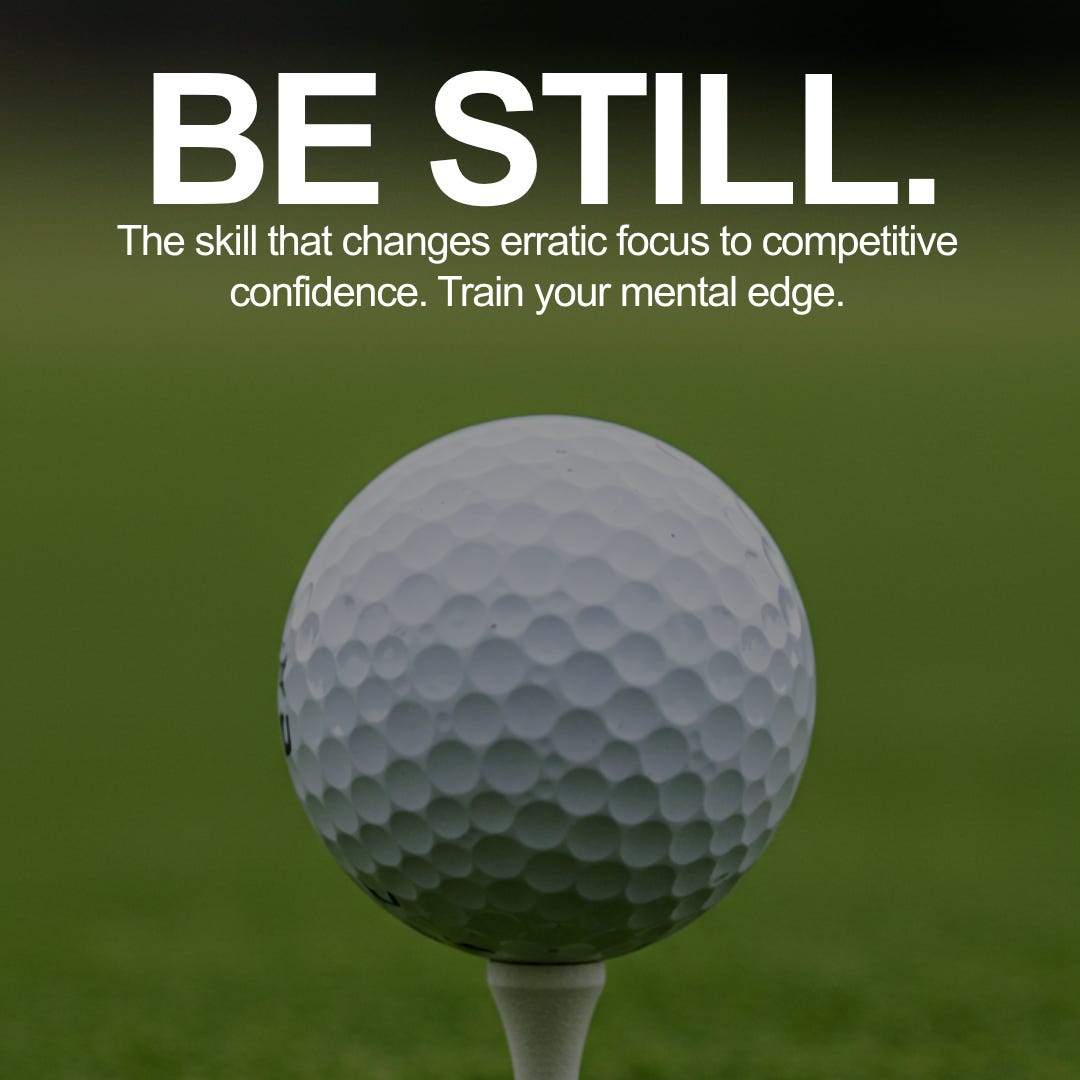
Stillness isn’t the absence of effort. It’s the presence of clarity.
High performers don’t struggle because they care too little. They struggle because they care so much. High performers care about outcomes, rankings, expectations, and the noise that comes with competing at a high level. In golf, that noise rarely shows up as chaos. It shows up as speed. Rushed routines. Busy minds. A body that’s technically ready, but mentally scattered.
This is what’s happening here: when pressure rises, most golfers try to add more thoughts, more control, more urgency. Stillness asks us to subtract.
And that’s where acceleration actually begins.
Stillness is a performance skill, not a personality trait
Psychologically, stillness creates space between stimulus and response. That space matters. It’s where emotional regulation and mental training lives. It’s where attention narrows instead of fragments and where the nervous system shifts from threat mode to performance mode.
Research on elite performers consistently shows the same pattern: the best don’t think more under pressure. They think less, and they feel more grounded in their bodies. Slowing the breath slows the heart rate. Slowing the heart rate steadies fine motor control.
You don’t become passive. You become precise.
Why slowing down helps you speed up
Golf rewards tempo, timing, and trust. None of those can be forced. When you pause… before the shot, after a mistake, between holes, you allow the brain to reorient around intention rather than reaction.
Reflection doesn’t pull you backward. It recalibrates your direction.
High performers who build in moments of stillness report greater clarity about why they’re playing, not just how. Purpose stabilizes performance. When the “why” is clear, decisions simplify and execution follows.
Here is a question I often ask my students when I notice noise inside their minds: “Where are you rushing right now? What might be available to you if you paused?
Stillness after mistakes is where resilience is trained
Most golfers rush too fast after a bad shot. This is often avoidance masked as resilience. Stillness after a mistake is uncomfortable. It forces awareness. It invites responsibility without judgment. That pause is where learning can happen. Neuroscience calls this consolidation. Faith calls it listening. Either way, stillness allows meaning to form instead of emotion to hijack the next swing.
You don’t need to replay the shot; you need to fully release it.
A quiet faith lens (for those who carry it)
Across Scripture, stillness is not framed as weakness, but as alignment. “Be still” is not a command to stop acting; it’s an invitation to stop striving. Psychologically, this mirrors what we know about trust under pressure. Spiritually, it reframes performance as stewardship rather than self-protection.
You’re not trying to prove. You’re preparing to respond.
Practicing stillness on and off the course
Stillness doesn’t require silence or solitude. It requires intention.
One breath before the shot.
One pause before reacting.
One reflective question at the end of the round: What did today teach me?
These moments compound. Over time, they rewire how you relate to pressure itself.
Because the goal isn’t to slow life down.
The goal is to move forward with clarity, purpose, and a calm center that holds the test of time, especially when everything else speeds up.
Where could stillness help you play faster, freer, and more like yourself?
Your Mental Coach,
Dr. Mat
P.S. YOU ARE INVITED!
Join us this January 29th at 7:30pm (ET) in partnership with the PGA NY Metro Junior Golf Section on a LIVE stream webinar…
Seats will fill up fast… save yours here.
