


I could stand over a five-foot putt with a tournament on the line and feel calm. Steady hands. Clear head. I could grind through a five and a half hour round in the Alabama heat and stay locked in on one shot at a time.
But I couldn’t pay a bill on time to save my life.
For years this made no sense to me. One plus one should equal two. How could the same person who stayed sharp when everything was on the line forget to do the simplest things at home? Late fees kept stacking up. I got so good at calling companies to talk my way out of them that it became its own skill. And still I never learned. I thought I just needed to try harder.
I was wrong about the problem the whole time.
The Dinner Table Diagnosis
I spent over a decade at NASA in organizational development, working inside some of the most complex systems you can imagine. Calm in crisis. Trusted under pressure. Sharp when the stakes were high. Then I’d come home and my brain let loose. No system. No priorities getting met. Just utter chaos.
My wife is a therapist. I’m a sport psychologist by training. You can imagine the conversations at our dinner table. For ten years she watched me repeat the same patterns, and one day she said, “Why do you keep doing this to me?”
My defense was always the same. “I swear I’m not doing this on purpose. I don’t know why I keep doing it.”
She started to see something I couldn’t. She told me to go get evaluated. ADHD was not even in my vocabulary. I played golf for hours at a time. I focused in school. I did not look like the stereotype in my head. So I dismissed it.
Then I got tested. And everything clicked.
Here is the part that matters for every parent reading this. I never had ADHD explained to me as a kid because I didn’t fit the picture. That is exactly the trap. The quiet, focused, high-performing junior golfer who somehow forgets their homework, loses their yardage book, and melts down after a bad hole might be running on the same wiring I was. You will miss it if you are only looking for the hyper kid who can’t sit still.
Flip the Script
Once I understood the brain underneath the behavior, none of it felt like a character flaw anymore. And that changes everything for a young athlete.
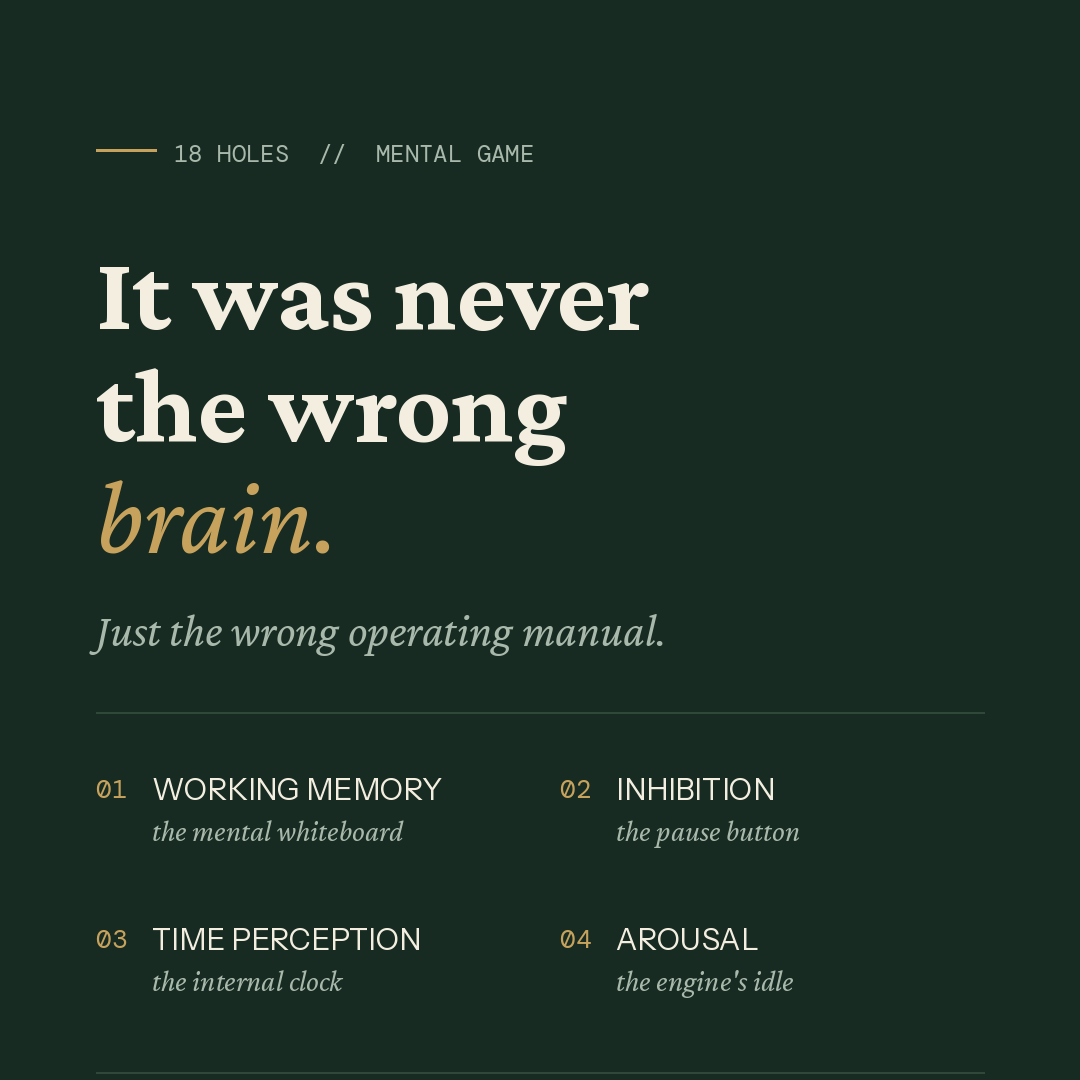
Your junior golfer is running their game on top of a brain. That brain has four background functions. Everyone has these four. People with ADHD just run them on different settings. Nothing is broken. The dials are set differently.
Here are the four, and here is how they show up on the golf course, in the classroom, and at home.
Working memory is the mental whiteboard. It holds what you need while you work through a problem. On the course it holds the yardage, the wind, the target, the last swing thought. For an ADHD brain the whiteboard erases fast. This is the kid who forgets their wedge on the last green, leaves the headcover on the cart, or blanks on the coach’s swing cue two holes later. Not because they don’t care. The board wiped before they could use it.
Inhibition is the pause button. It is the half second between an impulse and an action. For an ADHD brain that signal is weaker. On the course this is the rushed tee shot, the club thrown before thinking, the reply to a parent that comes out sharp. Here is the upside though. That same fast wiring is the kid who commits to an aggressive line while everyone else is still deciding. Fearless under pressure.
Time perception is the internal clock. It is your gut sense of how long things take. For an ADHD brain the clock is fuzzy. This is the player who thinks they have time for six more range balls before a lesson and shows up sprinting. It is the student who believes the project due in two weeks is not real until the night before.
Arousal is the engine’s idle speed. It is your baseline energy. For an ADHD brain the engine idles too low or runs too hot. A boring putting drill is genuinely painful to start. But hand this brain a final round with a trophy on the line and it roars to life with total focus.
Notice something. Every one of these is a double-edged trait, not a deficit. The same wiring that drops the ball on the boring drill is the same wiring that thrives when everything is on fire. My come-to-Jesus moment was realizing my job was never to fix my brain. It was to build systems that work with how it is already tuned.
The Fuel Is Different
Here is the piece that unlocks it. A neurotypical brain runs on an importance-based operating system. It asks, “Does this matter?” It ranks by priority and deadline, and that is enough to turn the engine over. For that brain, willpower actually works.
An ADHD brain runs on an interest-based operating system. It does not ask if something is important. It asks, “Is this interesting? Is this new? Is this urgent enough that the house is about to catch fire?” The reward chemistry means importance stays abstract. The kid knows the putting drill matters. That knowledge just does not register strongly enough to start the engine.
This is why your junior golfer can grind for four hours in a tournament and then refuse to do twenty minutes of putting practice on a Tuesday. They are not lazy on Tuesday and heroic on Sunday. They are running one consistent system tuned for high stimulation. Once you know the fuel, you can engineer it on purpose instead of waiting for pressure to force it.
Dr. William Dodson built a model I love for this. It is called PINCH, and it names the five things that actually start an ADHD engine.
Passion, meaning genuine interest. Intensity, meaning emotional charge. Novelty, meaning something new. Challenge, meaning a game to win. And Hurry, meaning real urgency.
Hurry works. It fires the threat response and produces that night-before-the-deadline magic. But if urgency is the only lever your athlete has, they live on adrenaline and burn out. The goal is to reach for the other four so panic is not the only switch.
The Faith Layer
I judged myself for years. Why can I not do the simple things? What is wrong with me? I carried that quietly, the way a lot of high performers do.
Then I read this brain the way I believe it was made. Fearfully and wonderfully. Not a mistake on a birth certificate, which, funny enough, is how I ended up with one T in my name. The wiring that almost broke me is the exact same wiring people now pay me to borrow as a coach.
Your child was not handed the wrong brain. They were handed the wrong operating manual. Part of a parent’s job, and a coach’s job, is to help them find the right one before they spend years believing they are the problem. Grace does not mean lowering the standard. It means separating the child from the behavior long enough to build something that actually helps.
What To Build
These are not productivity hacks off Instagram. They are engineering solutions for an interest-based nervous system. Pick one and make it real this week.
Externalize everything. The ADHD brain processes brilliantly and stores poorly. Stop asking your athlete to hold it in their head. Move it to the wall. One calendar the whole family can see. Visual timers. Alarms for range time, lessons, and study blocks. A yardage book habit where the next thought gets written down before the moment passes. That messy desk covered in sticky notes is not a defect. It is an external hard drive.
Use the pause script. The reactive yes is an ADHD tax. Your junior golfer overcommits to tournaments, drills, and favors because inhibition fires slow. Dr. Daniel Amen teaches one line that buys the brain time. “I have to think about it.” Six words. Teach your child to say it out loud before they commit to anything, on or off the course.
Build a body double. Working next to another person turns their focus into your focus. This is why practice with a partner beats practice alone for these kids. It is why the study group works when the solo homework does not. I would not have finished my dissertation without a friend beside me in a lab who had nothing in common with me except that his presence kept me on task. Set your athlete up next to a teammate, a sibling, or a parent in the room.
Engineer the PINCH on purpose. Do not wait for motivation. It will not arrive on schedule. Make the boring drill a game. Add a micro deadline. Change the practice green. Turn twenty putts into a competition against yesterday’s number. You are injecting novelty and challenge until the engine catches.
Protect recovery. This brain runs hotter and depletes faster. Sleep, movement, and rest are not nice-to-haves for a young athlete. They lower the engine’s idle speed. And here is the hard part. Rest is not in the ADHD playbook, so you have to schedule it. Put it on the calendar the same way you schedule a lesson.
The Cost Nobody Talks About
Before we finish, I have to be honest about two hidden costs, because if you parent or coach one of these kids you need to see them coming.
The first is rejection sensitive dysphoria (RSD). Perceived criticism registers in this brain like physical pain. A flat tone, a short text, a coach’s sigh after a bad hole can flatten a young athlete for a week. They are not being dramatic. Their nervous system is amplifying the signal. Choose your tone after a rough round carefully, because they are not living inside your intentions. They are living inside your patterns.
The second is masking. To fit into a world built for a different brain, these kids build a normal persona, often without knowing it. But the mask burns the exact traits that make them special. The scanning, the fast switching, the creative lines other players never see. If your junior golfer feels exhausted after holding it together all day, the mask may be quietly destroying the very talent you want to protect.
My Confession
I need to own something. For ten years I created chaos at home and hid behind my good intentions. “I swear I’m not doing this on purpose.” That was true. And it did not matter.
ADHD explains behavior. It does not erase impact. My family did not experience my intentions. They experienced my patterns. The sharp reply. The forgotten pickup. The late night when I was painting a bathroom wall because it felt urgent while a real deadline sat ignored.
So when I miss now, and I still miss, I try not to defend it. I repair.
“You’re right. I changed the plan. That affected you, and I own it. Here is the system I am changing so it happens less.”
Rapid ownership plus a visible system builds more trust than any explanation. Explanations sound like excuses. A changed system sounds like respect.
If your junior golfer melts down and then rushes to explain why it was not their fault, teach them repair instead. It will serve them longer than any swing.
Your One Rep This Week
Do not try to fix the whole system at once. Pick one externalized tool and install it. A shared calendar. A visual timer for practice. The pause script taped where your athlete will see it. Then do the only thing that matters. Practice it. A system does nothing while it stays in your head.
And if a young player in your life keeps missing the simple things, resist the lecture. Hand them a manual instead. That is what my wife did for me. That is the whole difference.
Interest is what gets you started. Systems are what get you trusted.
Your Mental Coach,
Dr. Mat
P.S. I recently led a workshop on ADHD and high performance for the IEB entrepreneur group. The room was founders and business owners, not junior golfers, but the wiring is the same and so are the systems. Watch the whole thing here:
Dr. Mat is a mental performance coach and sport psychologist, founder of the Mental Performance Golf Academy at mpgagolf.com, and author of ONE: A Spiritual Playbook for the Mental Game of Golf.